FPV Drone Filming in Los Angeles for Film, TV & Commercials
FPV (first-person view) drones are the shots that make an audience lean forward: a camera that dives off a rooftop, threads a doorway, tracks a car at speed, and keeps going. Lithium Aerials is a Los Angeles FPV drone crew for film, television and commercials. We fly FPV as one tool among several, alongside our aerial cinematography and heavy-lift work, so we'll tell you honestly when FPV is the right call and when it isn't. Every shoot is backed by $5 million in aviation liability coverage, and our FAA Section 44807 exemption lets us fly heavy-lift aircraft over 55 lbs.
What FPV Is Good For on Set
A traditional drone moves smoothly but keeps its distance. An FPV pilot flies the camera like a body moving through space. That opens up a handful of shots that are hard or impossible to get any other way.
Fly-throughs
Through windows, under bridges, between set pieces, down a hallway and out the back door. A fly-through connects spaces in a way a cut can't, and it tends to be the shot people remember from the trailer. For more on how FPV is reshaping aerial work, read our post on how FPV drone filming is changing aerial cinematography.
Vehicle and chase work
We fly FPV for vehicle work: tracking alongside a car, sweeping over the roof, dropping in behind it as it pulls away. FPV can change height and direction quickly enough to stay with a moving vehicle in ways a camera car or crane can't. If you're shooting cars, see our drone services for car commercials.
Interiors and tight spaces
Warehouses, stages, stadium concourses, restaurants, houses. Small ducted FPV drones can fly indoors and close to talent where a larger aircraft has no business being.
One-ers
A single continuous move that starts wide outside and ends on a close-up inside. These take rehearsal and coordination with every department, and they're where an experienced FPV pilot earns the day rate.
Cinewhoop vs. Full-Size FPV
"FPV" covers a range of aircraft, and picking the right one is half the job.
Cinewhoops
A cinewhoop is a small FPV drone with guards around the props. It's built to fly slowly and precisely near people, inside buildings and around set dressing. Cinewhoops carry lighter cameras, so they're the choice when access and safety matter more than maximum image quality. Ours typically fly a GoPro.
Full-size FPV
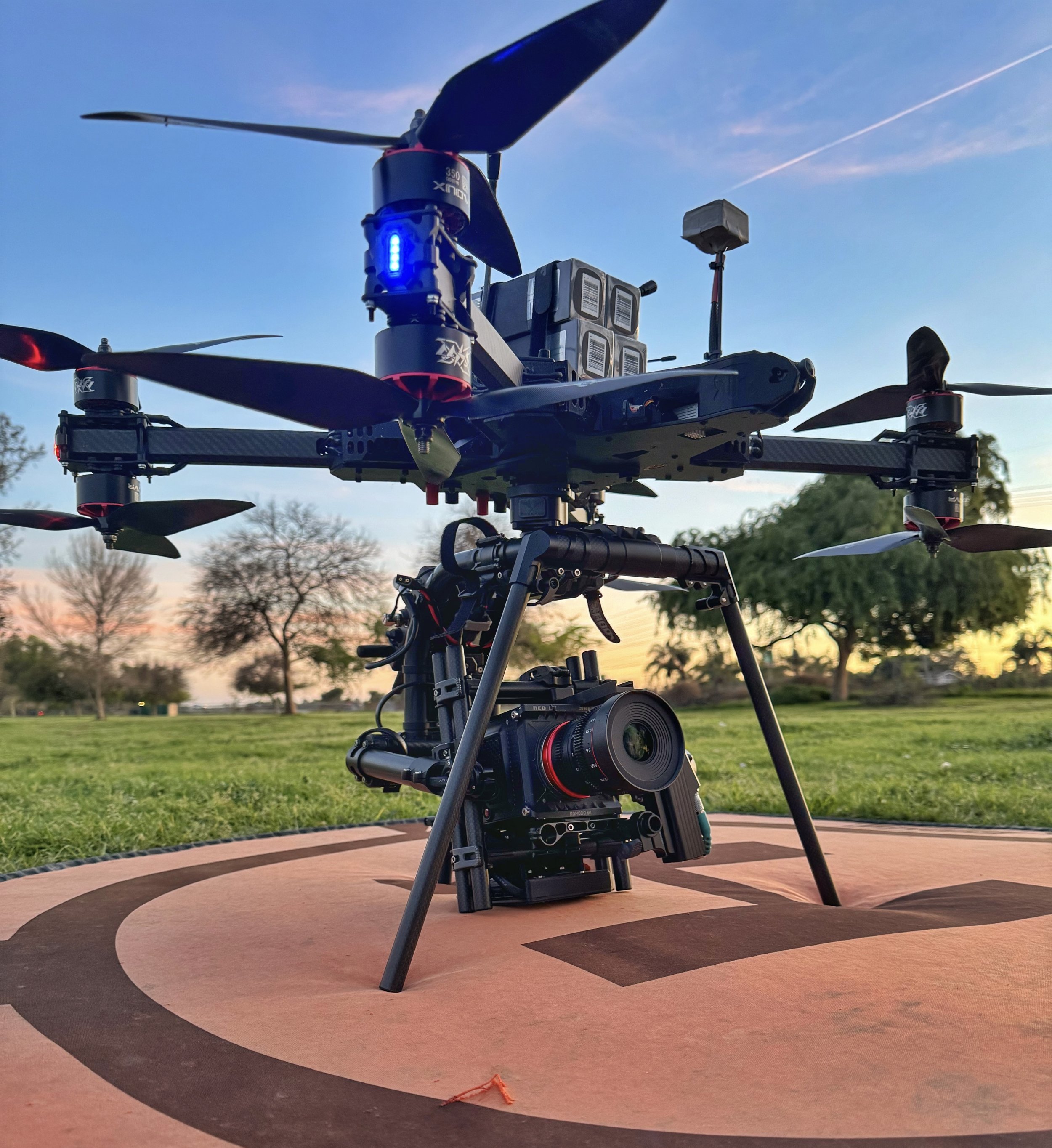
Larger FPV platforms are faster and carry heavier payloads, which means a bigger camera and better glass. They're the tool for exterior speed: vehicles, landscapes, big reveals. They need more room and a more controlled set.
Carrying cinema cameras
When the shot has to cut seamlessly with the A-camera, the camera on the drone matters. Our full-size FPV builds typically carry box-style cinema cameras like the RED Komodo, and we match the airborne camera to your show's format as closely as the shot allows. When a move needs a full-size cinema camera with no compromises, we can move it to a heavy-lift platform instead. See our aerial cinematography services for heavy-lift options.
Safety, Permits and Insurance
FPV gets close to people and things by design, so the paperwork and the planning matter as much as the flying.
Pilots: Every Lithium Aerials shoot is flown by FAA Part 107-certified pilots.
Insurance: $5 million in aviation liability coverage. Certificates of insurance are typically turned around the same or next business day.
FAA approvals: We hold an FAA Section 44807 exemption to fly heavy-lift aircraft over 55 lbs, and we secure airspace authorizations and other FAA approvals as each shoot requires.
FilmLA: We prepare all drone-specific paperwork and work directly with your locations team. The production pulls the permit.
On the day, we brief the 1st AD and safety, walk the flight path, rehearse the move, and keep people clear of the line of flight. If a shot isn't safe to fly, we'll say so and offer an alternative.
Hiring an FPV Drone Operator
Prep
It starts with a call. Send boards, a shot list or a reference clip, plus locations and dates. We'll tell you whether the shot is an FPV shot, which aircraft fits, and what approvals the location needs. Lead time is usually set by the film commission's permit timeline, typically 3 business days.
Scout and paperwork
For anything complicated, we scout or review the location, plan the flight path, request airspace authorization if it's needed, send your COI, and prepare the drone section of the FilmLA application for your locations team.
Shoot day
We arrive, set up, run a safety briefing and rehearse with the departments the move touches: talent, picture cars, art, SFX. Then we fly it until you have it.
Wrap
We often stabilize GoPro footage before handing it off, then deliver media according to your DIT's workflow and pack out.
FPV Drone Filming Across Los Angeles
We're based in Los Angeles and fly all over Southern California: downtown rooftops and alleys, Hollywood and Burbank stages, Culver City and West LA, the Santa Monica coastline, desert roads and mountain highways for vehicle work. Most LA locations come with some combination of controlled airspace, FilmLA requirements and neighbors, and we plan for all three before we arrive.
Our Work
Lithium Aerials has provided aerial support on feature films, network and streaming series, and national commercials. See our work. For night exteriors that need light rather than a camera in the air, see drone lighting, or browse all of our Los Angeles drone services.
FPV Drone Filming FAQ
What is FPV drone filming?
FPV stands for first-person view. The pilot flies through goggles that show a live feed from the drone, which allows fast, close, acrobatic camera moves such as fly-throughs, vehicle tracking and continuous one-ers that conventional drones can't match.
What is a cinewhoop?
A cinewhoop is a small FPV drone with ducts or guards around its propellers. It's designed for slow, precise flying close to people and indoors, so it's the usual choice for interiors and tight spaces.
Can FPV drones carry cinema cameras?
Yes, depending on the aircraft. Small cinewhoops typically carry a GoPro, while larger FPV builds carry box-style cinema cameras like the RED Komodo. When a shot needs a full-size cinema package, a heavy-lift drone is often the better tool.
Can you fly FPV indoors or on a stage?
Yes. Interiors and stages are some of the best places to use FPV, usually with a cinewhoop. We plan the path and rehearse it with the departments involved before we fly.
Do you handle FilmLA permits for drone shoots?
We prepare all drone-specific paperwork and work directly with your locations team. The production pulls the permit.
Are you insured, and how fast can we get a COI?
Yes. We carry $5 million in aviation liability coverage, and certificates of insurance are typically turned around the same or next business day.
Let's Talk FPV
Send us your boards, a reference clip or just the idea. Call 323-505-7104 or contact us, and we'll tell you straight whether FPV is the right tool for the shot.